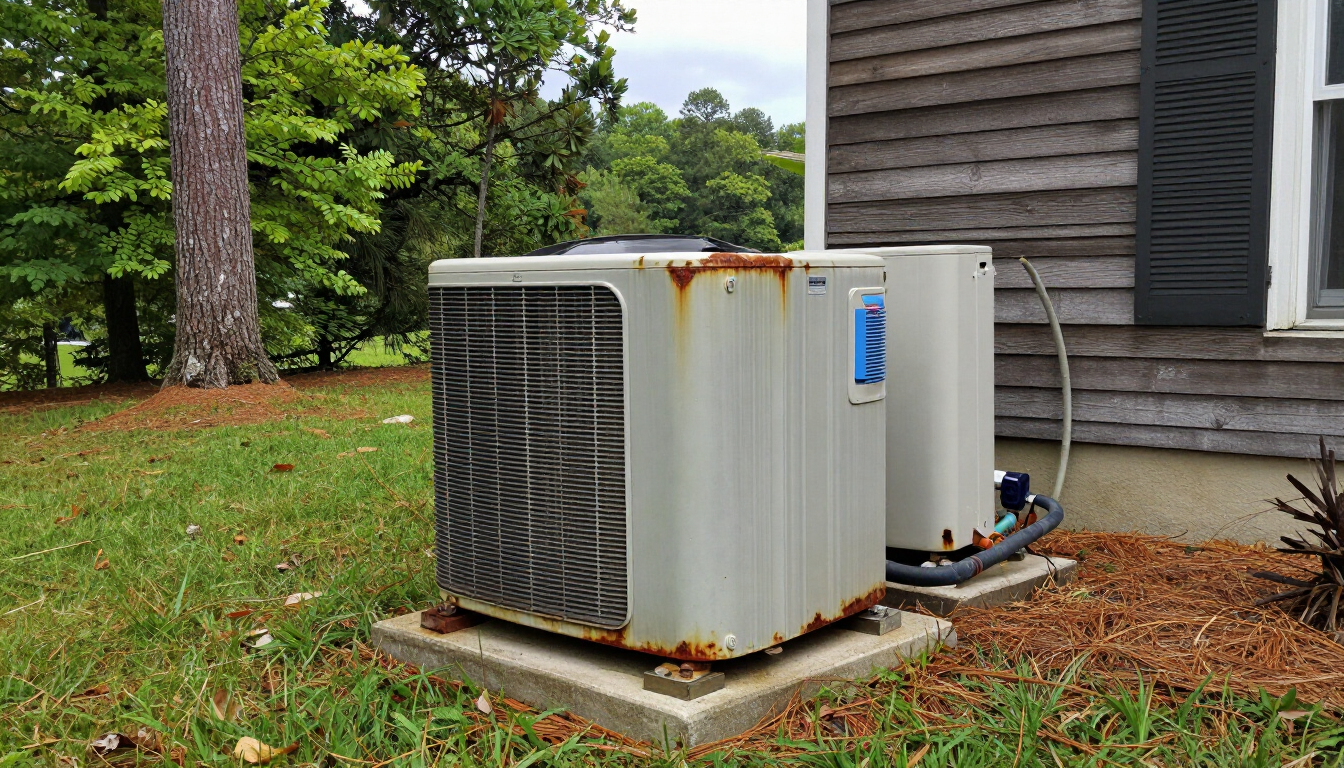
It is the peak of summer in East Tennessee. Temperatures are pushing 90 degrees, the humidity is thick enough to cut with a knife, and your air conditioner has been running relentlessly to keep your family comfortable. You notice the house is starting to feel a little warm, so you go to inspect the indoor unit.
When you open the utility closet or check the outdoor condenser, you see something that makes absolutely no sense: a thick, solid layer of white ice completely encasing the copper pipes and metal coils.
How can a machine freeze solid in the middle of a sweltering July afternoon?
At
Ashton Britt Service Company, frozen air conditioners are one of the most common emergency calls we receive during the summer months. While it looks bizarre, a frozen AC is a massive red flag that your system’s internal physics have been severely disrupted. If you are currently staring at a block of ice on your HVAC unit, here is the science behind why it is happening, what caused it, and the exact steps you need to take right now to prevent catastrophic damage.
1. The Science of the Freeze (Why It Happens)
To understand why your air conditioner is freezing, you have to understand how it actually cools your home. Your AC does not "create" cold air; it acts as a massive heat sponge.
The indoor evaporator coils are filled with ultra-cold, pressurized liquid refrigerant. Warm, humid air from your house is blown across these coils. The refrigerant absorbs the heat out of the air, and the newly cooled air is pushed back into your rooms.
For this delicate thermal exchange to work, a constant, massive volume of warm air must constantly flow over the coils to keep the refrigerant above the freezing point. If anything disrupts that airflow, or if the refrigerant pressure drops, the temperature of the coils will plummet below 32 degrees. The natural humidity and condensation in the air will instantly flash-freeze upon contact with the metal, creating a snowball effect until the entire system is encased in a solid block of ice.
2. Cause #1: A Suffocating Dirty Air Filter
This is the number one cause of a frozen air conditioner, and fortunately, it is the easiest to fix.
Your air conditioner needs to breathe. If your return air filter is completely caked in a thick layer of dust, pet hair, and dander, it acts like a brick wall blocking the warm air from reaching the evaporator coils. Without that warm air to regulate the temperature, the coils freeze almost instantly. During peak East Tennessee summers, standard 1-inch fiberglass filters should be checked and replaced every 30 days.
3. Cause #2: A Chemical Refrigerant Leak
This is a much more severe mechanical issue. The refrigerant (commonly known as Freon or R-410A) in your system operates inside a closed, sealed loop. An air conditioner never "uses up" or "burns" refrigerant.
If your refrigerant level is low, it means you have a chemical leak somewhere in the copper lines. When refrigerant escapes, the pressure inside the system drops. According to the laws of thermodynamics, a drop in pressure causes a severe drop in temperature. The remaining refrigerant becomes far too cold, causing the moisture in the air to freeze to the coils. A professional HVAC technician must locate the leak with electronic detectors, seal it, and recharge the system to the manufacturer's exact specifications.
4. Cause #3: Caked-On Dirt and Grime on the Coils
Even if your air filter is clean, the coils themselves can become incredibly dirty over the years. If the indoor evaporator coils are covered in a layer of sticky dust and grime, that dirt acts as a powerful insulator.
The coils become physically separated from the warm air blowing across them. Because the refrigerant cannot absorb the heat through the blanket of dirt, the temperature drops, and the ice begins to form. This is exactly why routine, professional preventative maintenance and coil cleanings are so critical before the summer heatwave hits.
What to Do Immediately (And What NEVER to Do)
If you discover ice on your system, you must take immediate action to protect the incredibly expensive compressor.
Step 1: Turn the AC OFF immediately. Do not try to force it to keep cooling. If the compressor tries to pump liquid refrigerant through a frozen solid line, it will literally tear itself apart, turning a simple repair into a $3,000 replacement.
Step 2: Turn the Fan to "ON." Go to your thermostat and switch the fan setting from "Auto" to "On." This will force the indoor blower motor to continuously blow warm room air over the ice, accelerating the melting process.
Step 3: NEVER scrape the ice. Do not take a screwdriver, an ice pick, or a knife to the coils to try and break the ice off. The copper and aluminum fins are paper-thin. If you puncture one, you will instantly vent all of your refrigerant into the atmosphere and destroy the coil entirely. You simply have to wait for it to melt naturally.
Trust the Experts at Ashton Britt Service Company
Once the ice has completely melted, the root cause of the freezing must be diagnosed and repaired before the system is turned back on.
At
Ashton Britt Service Company, we have over 20 years of experience diagnosing complex thermal and mechanical HVAC failures. Whether you need a simple professional coil cleaning or a complex refrigerant leak repair, our highly trained technicians will provide you with honest, transparent advice to get your home cooling safely again.
We proudly serve homes and businesses across East Tennessee, including:
- Jefferson City, TN
- Morristown, TN
- Rutledge & Rogersville, TN
- Sevierville & Newport, TN
- Knoxville, TN
Don't let a frozen AC ruin your summer comfort. Contact
Ashton Britt Service Company today at
(865) 475-0707 or visit our website to schedule your expert diagnostic assessment!